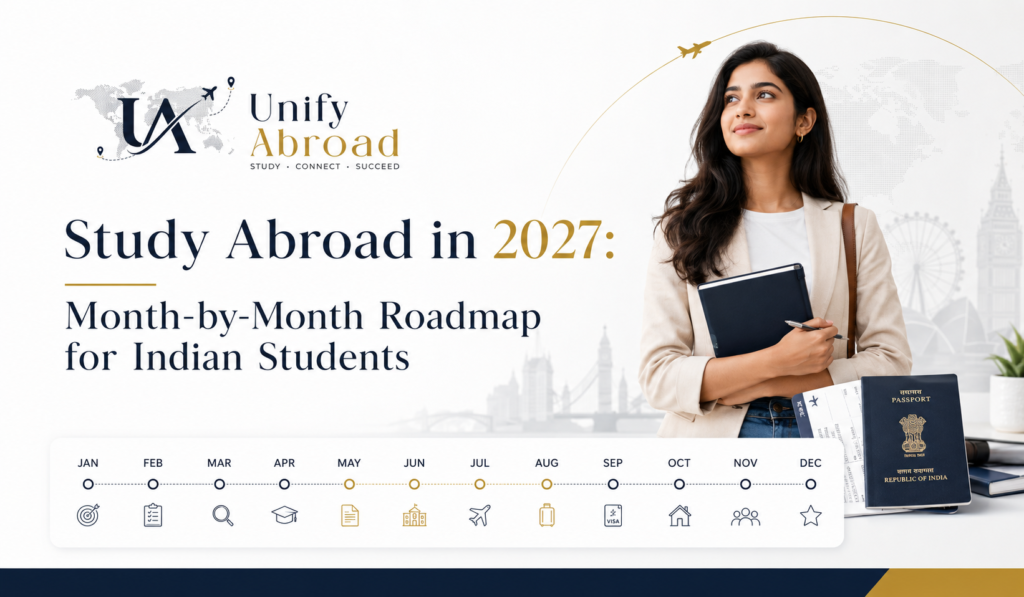
For competitive universities, scholarships and popular destinations such as the USA, UK, Canada, Australia, Germany, and Ireland, students who begin planning 10–15 months before departure usually have far more control over their choices.
Starting early gives you time to improve an English-language score, retake an entrance test, strengthen your profile, compare universities properly, apply for scholarships, and arrange an education loan without panic.
The reference roadmap published by NDTV makes the same broader point: studying abroad is no longer something students should begin planning only after graduation. Research, applications, funding, visa preparation, and departure all have their own timelines.
For Indian students targeting a 2027 intake, the process should begin now.
Study Abroad 2027 Timeline: Quick Answer
If you plan to start university abroad between August and September 2027, use this broad timeline:
|
Period
|
What You Should Do
|
|---|---|
|
August–September 2026
|
Choose country, course, budget, and universities
|
|
September–October 2026
|
Take IELTS/TOEFL/GRE/GMAT if required
|
|
October–December 2026
|
Prepare SOPs, LORs, transcripts and applications
|
|
November 2026–February 2027
|
Submit university and scholarship applications
|
|
February–April 2027
|
Track decisions and compare offers
|
|
April–June 2027
|
Finalise university, scholarship and education loan
|
|
June–August 2027
|
Complete visa, accommodation and travel formalities
|
|
August–September 2027
|
Pre-departure preparation and travel
|
Exact deadlines vary by university and country, so this should be treated as a planning framework rather than a universal deadline calendar.
Why Starting Early Matters More for the 2027 Intake
International admissions are becoming increasingly deadline-driven.
For example, applications for UK undergraduate entry in 2027 already opened on 12 May 2026, and completed applications can be submitted to UCAS from 1 September 2026. Oxford, Cambridge and most medicine, dentistry, and veterinary courses have an equal-consideration deadline of 15 October 2026, while the main equal-consideration deadline for most other undergraduate courses is 13 January 2027.
In the United States, application deadlines vary by university, but EducationUSA notes that undergraduate applications for a September start are commonly due between November and January.
The lesson is simple: if you wait until January 2027 to begin thinking about a Fall 2027 intake, many strong opportunities may already be closed.
August 2026: Decide What You Are Actually Looking For
Do not start by making a list of famous universities.
Start with four questions:
- What course do you want to study?
- What is your realistic total budget?
- Which countries support your career goals?
- What do you want to do after graduation?
A university may have a high ranking but still be wrong for you because of tuition fees, location, course structure, or weak career alignment.
Build an initial list of 10–15 universities and divide them into:
Ambitious: difficult but realistic.
Target: your profile broadly matches typical expectations.
Safer: you have a stronger probability of admission.
Students can also use Unify Abroad’s study-abroad planning tools to compare eligibility, expected costs, and scholarship possibilities before finalising destinations.
September 2026: Complete Your Tests
By September, you should know whether your target universities require:
- IELTS
- TOEFL
- PTE
- GRE
- GMAT
- SAT or ACT
- Portfolio or subject-specific assessment
Do not automatically take every test.
Check the exact requirement for each university.
TOEFL scores remain valid for two years, while IELTS recommends that test results normally be considered valid for a maximum of two years.
Taking an English test by September or October 2026 leaves enough time for a retake if your score is below your target.
October 2026: Build Your Application Documents
October should be your documentation month.
Start preparing:
- Academic transcripts
- Degree or provisional certificates
- Passport
- Updated CV
- Statement of Purpose
- Letters of Recommendation
- Work-experience documents
- Portfolio, where required
- Financial documents for scholarships
A common mistake is spending weeks perfecting university rankings while leaving the SOP and LORs until the final few days.
Your application documents often decide how effectively the admissions committee understands your academic story.
For U.S. applications in particular, EducationUSA recommends starting early because applications may require essays, recommendations, transcripts, and examination results, with requirements varying significantly between institutions.
November–December 2026: Start Applying
Do not wait until every university reaches its final deadline.
Apply as soon as your application is genuinely ready.
Early submission can be especially useful where:
- Scholarships have separate deadlines.
- Courses fill progressively.
- Universities use rolling admissions.
- You need additional time to arrange funding.
Create a tracking sheet containing:
- University
- Course
- Application deadline
- Scholarship deadline
- Application fee
- Test requirement
- SOP status
- LOR status
- Application status
- Decision date
If scholarships are important to your plan, review Unify Abroad’s guide to scholarships for Indian students studying abroad.
January–February 2027: Finish Applications and Prepare Funding
By early 2027, most serious applicants should have already submitted a large part of their university list.
Now shift your attention toward funding.
Calculate:
Tuition + living expenses + insurance + visa + travel + university fees + emergency reserve.
Do not calculate only the first semester.
- Families should compare:
- Personal savings
- University scholarships
- Government scholarships
- Secured education loans
- Unsecured education loans
- Assistantships, where applicable
The cheapest university is not always the best financial decision. A slightly more expensive university with a substantial scholarship may have a lower net cost.
March–April 2027: Compare Offers Properly
Getting three admission offers does not mean choosing the university with the highest ranking.
Compare each offer against:
- Total tuition
- Scholarship
- Living costs
- Course modules
- Internship opportunities
- Graduate outcomes
- Location
- Student safety
- Post-study work possibilities
- Loan requirement
Create a final net cost, not just a tuition comparison.
This is also the stage when students should read every condition attached to the offer letter before paying a deposit.
May–June 2027: Finalise Your University and Education Loan
Once you accept an offer, begin the financial process immediately.
Education loans can take longer than students expect, particularly when:
- Collateral valuation is required.
- Property documents need verification.
- The lender requests a co-applicant.
- The university wants proof of funds.
- Foreign currency disbursement is involved.
Do not wait until your visa appointment to discover that the loan is still being processed.
Unify Abroad provides support across university shortlisting, scholarship planning, education loans, visa documentation, and pre-departure preparation as part of its study-abroad counselling process.
June–August 2027: Student Visa and Pre-Departure
Once your university documentation is ready, move to visa preparation.
Typical requirements may include:
- Passport
- Admission document
- Proof of funds
- Tuition-payment evidence
- English-test results
- Health insurance
- Biometrics
- Medical examination
- Police clearance, depending on destination
Requirements vary significantly by country.
Never assume that receiving an admission letter automatically guarantees a visa.
Universities decide admissions. Government authorities decide visas.
Important USA Update for Students Planning to Study in 2027
Students considering the United States need to understand a separate immigration development that is not part of the NDTV roadmap itself.
On 17 July 2026, the U.S. Department of Homeland Security published a final rule replacing the traditional Duration of Status (D/S) system for F and J nonimmigrants with a fixed period of admission.
The rule is currently scheduled to take effect on 15 September 2026.
Under the new framework, F-1 students may generally be admitted for the length of their academic programme, subject to a maximum fixed admission period of four years. Students needing additional time may have to formally request an extension of stay rather than relying automatically on D/S.
However, this is a fast-moving situation. The rule is subject to congressional review, GAO has raised an issue regarding the required delay before its effective date, and litigation challenging the rule was filed in August 2026. Students should therefore verify its implementation status immediately before travelling or making immigration decisions.
Why Did the U.S. Government Introduce the Rule?
DHS says the change is intended to improve oversight and programme integrity and make it easier for authorities to verify whether F, J and I nonimmigrants continue to maintain lawful status.
Under the older D/S system, eligible students could generally remain while they continued to maintain valid student status rather than receiving a specific departure date at admission.
The new approach places greater emphasis on a defined authorised period and formal extensions when more time is required.
Who Is Affected?
The rule covers:
- F-1 academic students
- J-1 exchange visitors
- Relevant dependants
- I-category foreign media representatives
For Indian students, the most important category is usually F-1.
Students entering U.S. universities after the new system takes effect should pay particular attention to the admission-until date recorded by U.S. immigration authorities.
What Should Current and Future U.S. Students Do?
If you are planning to study in the USA:
- Check the latest DHS and university international-office guidance.
- Keep your Form I-20 updated.
- Review your I-94 after every entry into the United States.
- Do not assume your visa expiry date and authorised stay are the same thing.
- Contact your university’s Designated School Official if your course may extend beyond your authorised period.
- Begin extension planning early if additional study time may be required.
The basic F-1 visa process still begins with admission to a SEVP-certified institution, registration in SEVIS, payment of the SEVIS I-901 fee and issuance of Form I-20 before the visa application.
Indian students considering the USA should also read Unify Abroad’s detailed guide to the new U.S. student visa rules for 2026.
Common Study Abroad Planning Mistakes
Starting with rankings instead of career goals
Rankings are useful, but they do not tell you whether a course matches your career plans or budget.
Applying too late for scholarships
Many scholarships close alongside—or before—regular university deadlines.
Taking unnecessary tests
Check whether your university actually requires GRE, GMAT, IELTS or another test before spending money.
Ignoring the total cost
Tuition is only one part of studying abroad.
Depending entirely on part-time work
Do not build a financial plan that only works if you immediately find employment overseas.
Treating visa preparation as the final week’s job
Financial evidence, immigration documents and interview preparation need time.
Practical 2027 Study Abroad Checklist
- Finalise course and career goal
- Set maximum family budget
- Shortlist countries
- Research 10–15 universities
- Check university-specific deadlines
- Book required entrance or English tests
- Prepare transcripts
- Draft SOP
- Request LORs
- Apply for scholarships
- Submit university applications
- Compare admission offers
- Calculate total cost after scholarships
- Arrange education loan or proof of funds
- Pay university deposit only after checking conditions
- Prepare student visa file
- Finalise accommodation
- Buy insurance where required
- Book travel
- Complete pre-departure preparation
FAQs About Studying Abroad in 2027
1. When should Indian students start preparing for the 2027 intake?
Ideally, students targeting an August or September 2027 intake should start between mid-2026 and September 2026. Starting 10–15 months early creates room for testing, applications, scholarships and visa preparation.
2. Is August 2026 too early to apply for 2027?
No. UK undergraduate applications for 2027 are already open for preparation, while many U.S. applicants will begin submitting applications during late 2026.
3. When should I take IELTS for Fall 2027?
September to November 2026 is a practical window for many students because it provides time for a retake before major application deadlines.
4. How many universities should I apply to?
There is no universal number, but 6–10 carefully selected universities across ambitious, target and safer categories is usually more sensible than submitting 20 poorly researched applications.
5. When should I apply for scholarships?
Begin researching scholarships while shortlisting universities. Many major awards close months before classes begin and some have deadlines earlier than normal admission deadlines.
6. Have U.S. student visa rules changed for 2027 applicants?
Yes. DHS published a final rule in July 2026 that is scheduled to replace Duration of Status with fixed admission periods beginning 15 September 2026. Because the rule is under legal and congressional scrutiny, students should verify its status before travel.
7. Can Unify Abroad help with the complete 2027 application process?
Yes. Unify Abroad provides counselling, university and course shortlisting, admissions support, scholarship guidance, education-loan assistance, visa support and pre-departure guidance.
Final Thoughts: Your 2027 Study Abroad Journey Starts Now
Studying abroad is not one application form followed by a visa.
It is a sequence of decisions.
The right course affects your university shortlist. Your shortlist affects your test requirements. Your applications affect your scholarship options. Your scholarship and loan decisions affect your visa file.
Starting early gives you room to make each of those decisions properly.
If you are targeting the 2027 intake and are still unsure about your country, university, course, budget, scholarship options or application timeline, this is the right time to get your plan reviewed.
Book Your Free Counselling Session with Unify Abroad
Get personalised support with:
- Country and course selection
- University shortlisting
- Application planning
- SOP and LOR guidance
- Scholarships
- Education loans
- Student visa documentation
- Pre-departure support
Start your 2027 study-abroad plan with clarity—not last-minute applications.
Ready to turn this into a real shortlist?
Book a free, no-obligation consultation and we’ll build a personalised plan around your actual eligibility, budget and funding options.
Book a Consultation